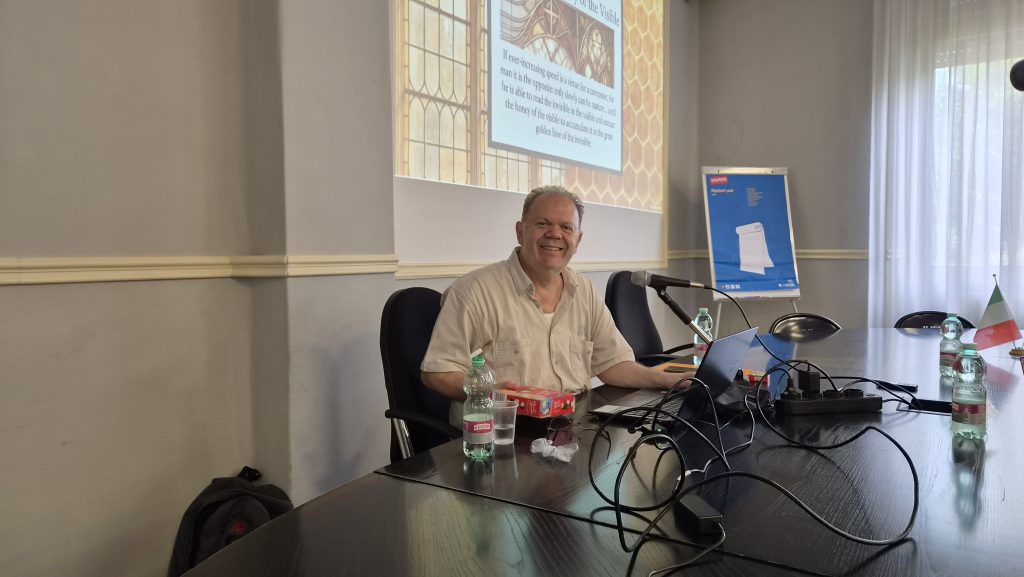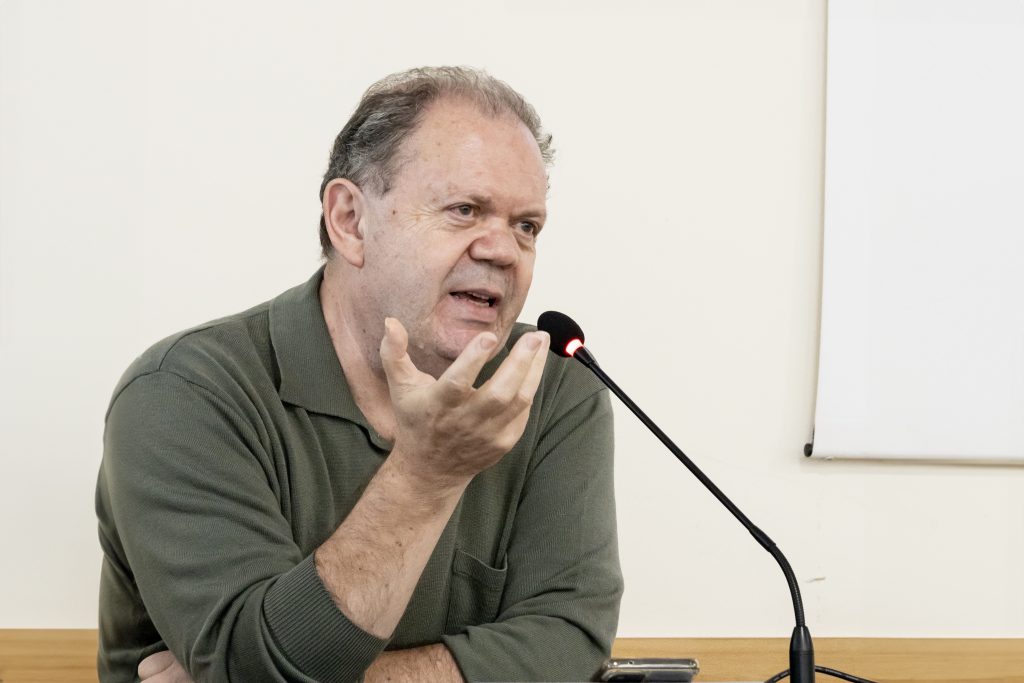
Despite the strong emphasis on Artificial Intelligence, I believe it’s important to reaffirm the immeasurable beauty and mystery of human life. The body is the site of this epiphany of mystery in which we experience this life. AI, however powerful and in many ways surpassing some of our capabilities, will never be able to understand and experience life.
Fabio Pasqualetti, sdb, Full Professor of Social Theories of Communication at the Faculty of Social Communication Sciences of the Pontifical Salesian University. Currently Dean of the Faculty. He teaches: Sociology of Digital Media; International and Development Communication; Doctoral Seminars and manages the Professional Internship. He is responsible for coordinating the Faculty’s technology sector.
 Loading…

 Reload document
  Open in new tab
 AI Summary:
- Human Limitations Versus AI Capabilities: Fabio Pasqualetti led a discussion on the philosophical and ethical limitations of artificial intelligence, emphasizing the distinction between human consciousness and machine simulation, with references to thinkers such as Federico Faggin and David Chalmers.
- Philosophical Reflections on AI: Fabio Pasqualetti used metaphors from religious texts and philosophical traditions to frame the human desire to transcend limitations through technology, drawing parallels between the pursuit of immortality in transhumanism and the mythic quest for godlike power.
- AI as Simulation, Not Cognition: Citing Anil Ananthaswamy and Alan Turing, Fabio Pasqualetti clarified that large language models and AI systems excel at simulation and mathematical optimization but lack true cognitive abilities, consciousness, or emotional qualia.
- Human Consciousness and Qualia: Referencing Federico Faggin and David Chalmers, the discussion highlighted that consciousness and subjective experience are not reducible to measurable or deterministic processes, setting a fundamental boundary between humans and AI.
- Role of Meaning and Interpretation: Fabio Pasqualetti explained that while AI can generate responses based on statistical models, it is humans who assign meaning to these outputs, especially in personal and interpersonal contexts.
- Societal Impact of AI and Social Media: Fabio Pasqualetti and participants examined the societal consequences of AI and social media, including issues of data control, attention economy, addiction, and the transformation of social platforms from networking tools to commercialized environments.
- Automatization of Social Life: The group discussed how AI is integral to the broader project of automating social life, with technology increasingly shaping environments and behaviors, often leading to reduced human agency.
- Data, Power, and Control: Participants noted the rise of ‘big data’ as a form of social control, with corporations leveraging user data for profit and influence, raising questions about freedom and autonomy.
- Attention Economy and Addiction: The conversation addressed how social media platforms, powered by AI, are designed to capture and monetize user attention, resulting in diminished attention spans and increased addictive behaviors, particularly among youth.
- Echo Chambers and Polarization: The group highlighted the role of algorithmic personalization in fostering echo chambers, societal polarization, and the loss of critical discussion and listening skills.
- Ethical and Educational Challenges of AI: The meeting explored the ethical responsibilities of individuals and institutions in the age of AI, with Fabio Pasqualetti and others emphasizing the need for critical literacy, responsible use, and the importance of human mediation in education and decision-making.
- Ethics by Design and Human Responsibility: Fabio Pasqualetti stressed that ethical considerations must be embedded in technology design and use, but ultimately, humans are responsible for ethical action and interpretation.
- AI in Education and Learning: The group discussed the risks of students using AI to shortcut the learning process, resulting in superficial understanding and lack of critical thinking, and emphasized the need for educational systems to foster deep engagement and effort.
- Role of the Church and Community: Participants considered how the Church and other community organizations can partner with schools and families to provide education on technology, promote values, and offer alternatives to digital engagement.
- Distinguishing Simulation from Authenticity: The discussion included concerns about AI-generated content in church communications, with Fabio Pasqualetti arguing that authenticity and credibility depend on real-life action, not just polished narratives.
- AI, Power Structures, and Social Justice: The group, including Fabio Pasqualetti, reflected on the intersection of AI, global power dynamics, and social justice, discussing issues such as exploitation in AI development, the lack of investment in solving poverty, and the asymmetry of power between users and corporations.
- Resource Consumption and Inequality: The meeting addressed the high energy and material costs of AI development, including conflicts over rare minerals, and noted that AI investment is concentrated where profit is possible, not where social needs are greatest.
- Exploitation in AI Supply Chains: Fabio Pasqualetti described how workers in the Global South are paid minimal wages to perform data labeling and other tasks essential for AI systems, highlighting ongoing patterns of technological colonialism.
- Advocacy and Alternatives: Participants discussed the need for advocacy, openness, and the creation of alternatives to current digital platforms, especially to protect vulnerable populations from harm.
- Balancing AI Use in Personal and Professional Contexts: A participant raised questions about achieving equilibrium between personal and professional use of AI, with Fabio Pasqualetti and others discussing strategies for responsible adoption, distinguishing between substitution and assistance, and maintaining human agency.
- Substitution Versus Assistance: The group distinguished between using AI to substitute for human effort (e.g., rewriting text entirely) and using it as an assistive tool (e.g., highlighting errors for correction), advocating for approaches that preserve individual effort and responsibility.
- Professional Efficiency and Human Attention: It was acknowledged that some professional tasks may benefit from automation, but participants emphasized the importance of maintaining personal attention and responsibility, especially in contexts involving human interaction.
- Church Engagement with AI and Technology: The meeting included discussion on the Church’s role in engaging with AI, including partnerships with technology companies, the challenge of credibility, and the importance of witness and action over mere communication.
- Partnerships and Ethics: Fabio Pasqualetti commented on the Vatican’s partnership with Anthropic and other tech companies, noting the complexity and ambiguity of such relationships and the need for ongoing ethical vigilance.
- Witness and Credibility: The group agreed that the Church’s credibility depends on authentic action and witness in local communities, rather than relying solely on digital narratives or large-scale events.